Pop Mart has a multi-center deal with Simon to expand throughout the U.S.

POP MART has cut a multi-center deal with Simon Property Group group to rapidly expand in the U.S. nationwide. The deal includes 20 Simon malls and Simon Mills projects.

This expansion is still part of the first phase for the toys and collectibles global chain to increase its presence in North America that began with the opening of its first location on a long-term lease at American Dream in East Rutherford, N.J. in September 15, 2023. The concept, while very popular in Asia, was virtually unknown in the Americas before Triple Five Group executive Laura DeSwart spotted it and convinced them to sign a long-term lease with American Dream mall.

Since then, POP MART has been expanding its footprint, and now operates more than 45 brick-and-mortar locations in the United States as well as more than a dozen in Canada.

Pop Mart’s U.S. presence is concentrated primarily in Western and Northeastern states, with California and New York leading in terms of store count. In California, there are multiple locations in Los Angeles County and the San Francisco Bay Area. Similarly, New York State accounts for six stores in NYC and additional stores in Albany, Buffalo and Long Island.

In Texas, POP MART operates stores in Austin, Dallas, Houston and San Antonio. Other notable markets include Florida (Miami and Orlando), Illinois (Chicago), Nevada (on the Las Vegas Strip) and Washington (Seattle). Markets with strong tourism, particularly international, as well as strong local AAPI culturally diverse residents are preferred.

The retailer has a long-term growth strategy in North America,” according to Luis Barrientos, executive VP of business development at POP MART.

Prior to the newly announced locations, POP MART had opened stores within the past two years at malls operated by other developers as well as Simon locations, including The Florida Mall (Orlando, Fla.) and Fashion Centre at Pentagon City (Arlington, Va.).

New POP MART locations to open at Simon malls:

- Brea Mall (Brea, Calif.)

- City Creek Center (Salt Lake City, Utah)

- Del Amo Fashion Center (Torrance, Calif.)

- Dolphin Mall (Sweetwater, Fla.)

- The Forum Shops at Caesars Palace (Las Vegas)

- King of Prussia (King of Prussia, Pa.)

- La Plaza (McAllen, Texas)

- Lehigh Valley Mall (Fullerton, Pa.)

- Menlo Park Mall (Edison, N.J.)

- Pheasant Lane Mall (Nashua, N.H.)

- Quaker Bridge Mall (Lawrence Township, N.J.)

- The Mall at Rockingham Park (Salem, N.H.)

- Twelve Oaks (Novi, Mich.)

- The Westchester (White Plains, N.Y.)

- Walt Whitman Shops (South Huntington, N.Y.)

- Westfarms (Farmington, Conn.)

New POP MART locations to open at Simon Mills:

- Arizona Mills (Tempe, Ariz.)

- Arundel Mills (Hanover, Md.)

- Grapevine Mills (Grapevine, Texas)

- Potomac Mills (Potomac Mills, Va.)

- Sawgrass Mills (Sunrise, Fla.)

Read more: Simon Adds More Pop Mart Stores to Its Shopping Locations (The Toy Book)
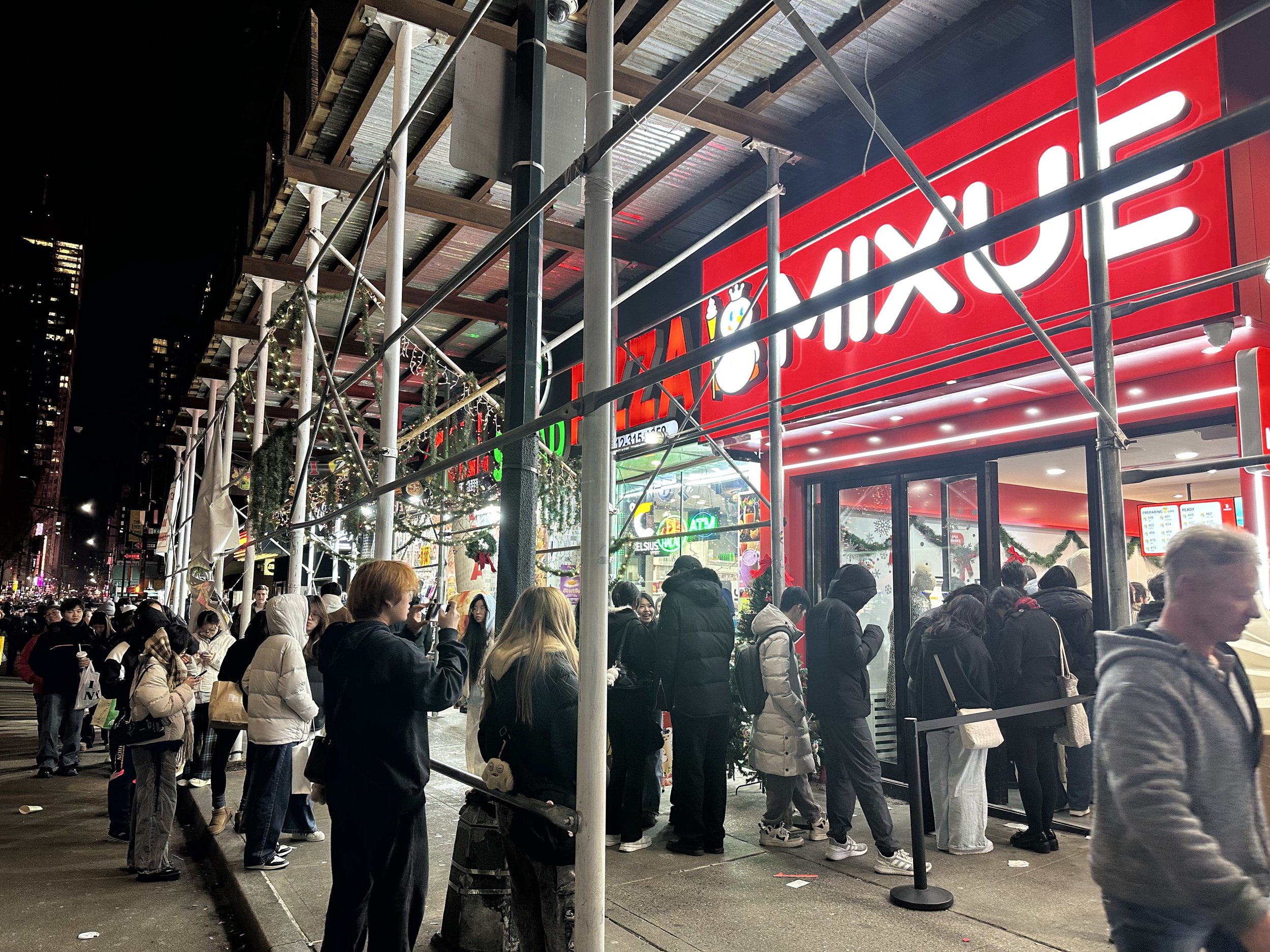
China-based beverage retailer Mixue is expanding in U.S. from coast-to-coast

On a recent visit to Midtown Manhattan, I was surprised to find long lines of more than 100 customers waiting to order from the new MIXUE Group beverage outlet on New York’s 8th Avenue. Most in the queue appeared to be of Asian descent, where Mixue is better known than Häagen-Dazs Shops.

The Chinese beverage giant Mixue is rapidly expanding globally, and in late 2025 entered the U.S. market for the first time with stores in Los Angeles (on Hollywood Blvd.) and New York (pictured below near the Port Authority bus terminal), with plans to rapidly open more locations in the U.S. and across the Americas.

The store leverages its massive supply chain to offer ultra-affordable ice cream (cones for $1.19) and specialty beverages including $1.99 for iced lemonades, $2.99 for lattes and bubble teas starting at $3.99.

Mixue is already the world's largest beverage chain by store count, with over 53,000 locations, surpassing Starbucks and McDonald's in store count but not in sales volume. By comparison, Starbucks has about 40,000 stores in 88 markets. Subway has about 37,000 locations and KFC has just over 30,000.

Most of Mixue’s stores are in China, but the company also operates about 4,700 stores across 13 additional countries including Australia, Japan, South Korea, Thailand, Malaysia and Singapore.

For Mixue's U.S. expansion, CBRE (specifically Jordan Kaplan, Eric Gelber and Jessica Tauber) represented them in New York City for key upcoming locations like Tribeca and Downtown Brooklyn, while Matthews™ (Scott Lifschultz and Myles Bazoian) represented Mixue for the Hollywood Boulevard flagship store, with additional tenant support from Elevate Crest Properties.

Amazon to open first Walmart-type Supercenter

Amazon is on its way to compete directly with Walmart and Target in the big-box, brick-and-mortar space when it opens its first new big-box store concept in the United States.

Amazon has applied for a permit to build a one-level, 229,000-square-foot store to sell groceries and general merchandise in the Village of Orland Park, southwest of Chicago.

If approved by officials in the village, Amazon could begin construction later this year. Earlier this month, the village planning commission reviewed the project, which has been endorsed by Orland Park Mayor Jim Dodge.

The proposal also includes multiple future retail outlots as part of the development concept, and is entirely commercial, according to village officials who have reviewed the plan. The store will sit on 35 acres.

The site of the proposed retail development at 159th Street and LaGrange Road in Orland Park is already surrounded by big-box retail including Target, Costco Wholesale and DICK'S Sporting Goods and is about a mile south of Orland Square Mall, owned by Simon Property Group.

The average size of Target’s large-format stores is about 150,000 square feet, while Walmart Supercenters can range between 100,000 to over 250,000 square feet, with the largest U.S. store in Albany, N.Y., being a two-level, 260,000-square-foot Supercenter.

Both Walmart and Amazon are among the largest companies in the world with projected annual revenue exceeding $7B in fiscal 2025.

While Amazon’s retail success has been through its pick-pack-ship operation over the years, the e-commerce giant has continued to experiment with physical store formats. Its most successful to date has been the Whole Foods Market operation created by acquisition.

Amazon launched a range of physical store formats between 2015 and 2020, including a bookstore, an eclectic, gift-focused outlet, automated checkout grab-and-go c-stores and a mainstream grocery chain. Most of those brands were wound down or saw expansion curbed, as the company struggled to find the right formula for in-person shopping under the Amazon brand.

Read more: Amazon Is Planning Walmart-Style Big Box Store Near Chicago (Bloomberg)

Dutch Bros accelerates national store expansion

Dutch Bros has more than doubled its store count to more than 1,000 units coast-to-coast since the chain’s IPO in 2021 and aims to double it again in just three years from now by 2029.

The chain is better known in the Southwest, where for the past 25 years it had been expanding before the company catapulted from a regional chain to a national coffee and fancy beverage provider with stores in almost half of the U.S. states on its way to achieving a national presence.

So, if you lease or operate shopping centers only in the Northeast, you may not be familiar with the brand other than hear about the chain’s recent expansion plans at ICSC deal making events. For those of you, here’s your lesson:

Dutch Bros Coffee Inc.—pronounced “bros,” not “brothers”—is a big chain of tiny drive-thru huts manned by relentlessly cheerful and chatty teenagers who serve a menu of $7 candy-colored coffee concoctions, energy drinks and lemonades.

Dutch Bros historically was concentrated in the West and South/Midwest, but has begun opening new stores or has disclosed plans to open in 2026 in key new markets in Florida, Tennessee, Georgia, South Carolina, Louisiana, Kentucky, Ohio and Indiana on its way to becoming a true national chain.

Started in Oregon by two brothers of Dutch descent, the company moved its headquarters to Tempe, Arizona, in June 2025. Christine Barone, a former senior vice president at Starbucks Corp., came on board as CEO in 2023, while one of the co-founders, Travis Boersma, directs strategy and serves as executive chairman. His co-founding much older brother, Dane, who operated a Dairy Queen franchise in the 1970s died of Lou Gehrig’s disease in 2009.

The chain’s leasing strategy seeks suburban locations along major transit routes, just as other fast-food and coffee retailers, but its buildings—all drive-thru locations—occupy less than 1,000 square feet and can be built out in four months, as little as half the time it takes to build a typical dine-in café or fast-food restaurant.

The drive-thrus are instantly recognizable, little bunkers of blue corrugated metal and gray brick.

Dutch Bros initially grew through franchising but no longer franchises; since 2017 every new shop has been company-owned. As the chain ramps up growth eastward, it opened roughly three stores per week in 2025 and will have to double that pace to reach its goal of having 2,029 stores by the end of 2029.

According to past analysts’s calls, the company sees a path to having as many as 7,000 units operating from coast to coast.

Read more: Dutch Bros Is Out-Starbucksing Rivals With the Sugariest Drinks (Bloomberg Businessweek)

Aldi aspires to operate 3,000 grocery stores in the U.S. by 2028

Make no mistake, ALDI USA continues to expand on its way to have more than 3,000 locations by the end of 2028. In fact, Aldi U.S. plans to operate more grocery stores in the country than any other chain but Walmart Inc.

And this trend has been going on for quite some time. As recent as 2024, the German discount grocery chain acquired Winn-Dixie and Harveys Supermarket in the Southeast and announced a $9 billion investment to open 800 more stores. By year end in 2024, Aldi became the fastest-growing U.S. grocery chain by both new store openings and square footage, according to JLL.

In 2024, sales at Aldi U.S. topped $29 billion, putting it squarely ahead of Trader Joe's, which had as much as $20 billion in revenue, according to an analysis by Scott Moses, partner and head of grocery, pharmacy and restaurants at investment banking firm Solomon Partners.

Aldi opened ~225 new store locations in the U.S. during 2025, marking the most it has ever opened in a single year. But the low-price no-frills grocer is not only opening stores in low income areas.

Of the Aldi stores that opened in late 2025, almost two-thirds are in ZIP codes with mid-to-high incomes, according to an analysis by RetailStat LLC, which analyzes retail financial and location data.

Aldi stores as smaller than standard supermarkets, often around 12,000 sq. ft. up to around 20,000 sq. ft., depending on format and market. Yet, sometime later this year, it will open its most audacious location yet, a 25,000-sq.-ft. store on the ground floor of the Ellery, a high-rise apartment building near New York’s Times Square.

Read more: The Curious Cult of Aldi (Bloomberg Businessweek)

Brookfield Properties is renaming retail division to GGP

GGP is back!!!

Brookfield Properties has renamed its retail division to GGP, the name of the quality mall company it acquired in 2018. At the time of the acquisition, GGP owned 122M sq. ft. of U.S. retail, putting it behind only to Simon Property Group. The division now has 101 U.S. retail properties.

The Brookfield retail division, renamed after General Growth Properties, which when public its shares traded on NYSE under the ticker GGP, will continue to be based in Chicago.

General Growth Properties was founded in 1954 by brothers Martin, Matthew and Maurice Bucksbaum in Cedar Rapids, Iowa. The company moved its headquarters to Des Moines, Iowa in 1964. In 1995, co-founder and CEO Martin died and Matthew became the sole CEO, who then moved the headquarters to Chicago in 1997.

In 1999, Mathew's son, john bucksbaum succeeded his father as CEO. Both Matthew and John served as chairmen of ICSC, the trade association of the retail real estate industry.

Read more: Brookfield's retail division has a new name — its old one (Crain’s Chicago Business)

Rhoback athleisure apparel brand opened first store in Charlottesville, Va.

Rhoback, a digitally native athleisure apparel brand opened its first store at the Barracks Road Shopping Center in Charlottesville, Va. last month, and cofounder Kevin Hubbard has already set his sight on running Rhoback physical stores nationwide (perhaps even globally) within 10 years, according to an interview with CBS19 News (Charlottesville).

The idea for Rhoback began while co-founders Matthew Loftus and Kristina Loftus studied at the University of Virginia Darden School of Business. In addition to her academic training, Kristina taught herself how to design clothing using Photoshop courses on YouTube.

Rhoback first started as a class project but later with Hubbard, the trio launched a line of upscale activewear and then opened their first warehouse in their hometown of Charlottesville to design and sell men’s and women’s apparel.

Since its founding in 2016, the apparel maker has grown into a 100-person company with over 3 million products sold online. The lifestyle activewear brand designs, manufactures and sells high-performance apparel that blends athletic function with a clean, lifestyle-inspired look. The brand’s logo is modeled after the Loftuses’ dog, Bunker, a Rhodesian Ridgeback breed.

To mass produce its quality products, they partnered with a trusted manufacturer in South Korea that offered standout fabrics and samples.

Rhoback has now partnered with RepSpark to streamline its wholesale operations and accelerate expansion into a variety of retail partners, including golf pro shops, collegiate bookstores and specialty retailers like Alabama Outdoors and St. Bernard Sports.

The brand also has a significant focus on collegiate apparel through its "Rhoback U" program. They currently work with over 50 colleges and universities and plan to add 30 more in 2026. This strategy builds brand awareness in specific regional markets through athlete partnerships and licensed merchandise.

Read more: RHOBACK’s first-ever brick-and-mortar opening at Barracks Road Shopping Center in Charlottesville (Federal Realty Investment Trust - LinkedIn)

Karat Home relaunching Z Gallerie physical stores

It looks like Z Gallerie, the home furnishings darling of lifestyle centers is slowly ramping up its brick-and-mortar strategy by opening pop-up stores.

Along with other disastrous bankruptcies by home furnishings retailers due to the crash in home buying after interest rates jumped in 2022, the popular chain filed for bankruptcy in 2023, its third bankruptcy filing, and closed all its physical stores.

Fortunately, online furniture retailer Karat Home Inc. acquired the chain out of bankruptcy in January 2024 and kept the Z Gallerie brand selling online.

A year later, Karat Home relaunched Z Gallerie physical stores starting with a warehouse outlet in Gardena, California (south of L.A.) in March 2025 and a 2,000-sq.-ft. pop-up location on a temporary license agreement in Galleria Dallas in Nov. 2025.

Reportedly, Scarlett Fan, now CEO of Z Gallerie and founder of Karat Home wants to open more physical locations in 2026 and is looking at sites in Texas and elsewhere.

Read more: Z Gallerie Locations (Z Gallerie)

Dying malls can be converted to data centers

As data centers become larger, more urbanized and in greater demand due to the increasing needs for AI infrastructure, we will likely see more retail-to-data center conversions. And that includes the dying malls, which is nothing new.

For example, as early as 2008, Eastgate Consumer Mall began converting to a an office park and data center owned by Lifeline Data Centers, LLC (Indianapolis, Ind.). Between 2012 and 2013, AiNET converted a former Boscov's Department Store, LLC at Marley Station Mall into its CyberNAP data center. And currently, the Landover Mall property (Prince George’s County, Md.) — demolished years earlier — is under consideration as a data center campus called Brightseat Tech Park with potential groundbreaking in 2026.

Malls work as data center conversion for four reasons:
• They are large (500,000 – 1,200,000 sq. ft.)
• They have large column spacing
• They are located within central utility corridors
• They have ample parking, where one can build power substations and generators

A dead 900,000 sq. ft. mall can support ~40–80 MW traditional cloud data center or ~25–50 MW AI / high-density workloads. Power availability is usually the real constraint.

As of last year, U.S. data center inventory accounted for ~180–200 million sq. ft. Within five years, +100–150 million sq. ft. of additional space for data centers is required.

Data centers of various sizes will be built between 2026 and 2030:
• Small data center: ~50,000–100,000 sq. ft.
• Mid-scale colocation: ~200,000–400,000 sq. ft.
• Hyperscale / AI campus: 500,000–1,500,000+ sq. ft.

However, power availability matters more than square footage, so power generating sources are needed whether data centers are mall conversions or they are built on greenfield.

Stargate Project, a collaboration of OpenAI, Oracle and SoftBank Group Corp., with support from the U.S. government in Abilene, Texas (180 miles west of Dallas) is being built on greenfield. It will have a mighty capacity of 1.2 gigawatts with its own gas power plant. The Stargate site—spanning 900 acres is larger than New York City’s Central Park.

Pacsun reopening stores again in the U.S. and abroad

Remember PACSUN, the mall-based specialty store chain formerly known as Pacific Sunwear that hasn’t increased its store count in nearly two decades? Well, that has changed: The youth oriented apparel chain is opening new stores in the U.S. and internationally as the retailer touts its brick-and-mortar expansion plan.

In 2025, Pacsun opened nine new U.S. stores. Looking ahead, the brand plans to add 20–35 new stores over the next three years, with nine leases already signed for 2026 — marking its most ambitious domestic retail expansion in 18 years.

The retailer also signed a lease to open a store at Mall Of The Emirates in Dubai. The debut flagship Dubai store, set to open in early 2026, marks Pacsun's first international location in its 40-year history.

Through an exclusive regional partnership, Majid Al Futtaim and Pacsun plan to open as many as 20 stores across the Middle East over the next five years, including another flagship location in Abu Dhabi.

What’s behind this new resurgence at Pacsun? Brieane Olson, the new CEO, that has been focusing on Gen Z and is now doubling down on a brick-and-mortar strategy.

She rose through the ranks at Pacsun, proving herself along the way. During her tenure at Pacsun, Olson spearheaded innovative collaborations for the L.A.-based lifestyle brand, including working closely with Kanye West and Kendall and Kylie Jenner and launching both men’s and women’s shops inside Selfridges in 2018 with launch parties hosted by Pacsun partner Jerry Lorenzo.

She was promoted to president of Pacsun in 2021 and transitioned to her new role as CEO in April 2023. Pacsun now operates approximately 300-plus stores, so it has the ability to significantly grow its presence without cannibalization of its brand.

Read more: Pacsun Expands Globally: Announces First U.S. Store Count Increase in Nearly Two Decades and Opens First International Store in Dubai (Morningstar)

L.L. Bean announces 2026 brick-and-mortar store expansion

Greg Elder, L.L.Bean's chief retail officer and his team have released plans for continued brick-and-mortar store expansion, which includes eight new L.L. Bean stores in 2026.

Alabama and Tennessee are new states for the outdoor apparel and gear chain with new stores in Huntsville, Ala. at the Bridge Street Town Centre (a Tanger center) and one in Franklin, Tenn., south of Nashville.

The company’s planned 2026 openings will bring its total store count to 76 stores in 21 states. In 2027, it plans to further continue expanding with eight to 10 new stores, including first-time stores in new markets in the Midwest and Southeast.

Read more: L.L. Bean to Open Eight Stores, Unveil Reimagined Flagship in 2026 (Women’s Wear Daily)

N.J. malls converting to mixed use, adding multifamily

Six New Jersey malls are undergoing re-development. The common thread: All are converting to mixed use and adding multifamily apartments.
- Brunswick Square Mall (Paramount Realty)
- The Outlets at Bergen Town Center (Urban Edge Properties)
- Monmouth Mall (Westminster Management Corporation)
- Moorestown Mall (PREIT)
- Voorhees Town Center (Namdar Realty Group LLC)
- Westfield Garden State Plaza (Unibail-Rodamco-Westfield)

Read more: 6 nostalgic malls get sweeping makeovers as expert warns shoppers have ‘stopped tolerating dull stores’ (The U.S. Sun)

Dine Brands Global to grow dual Applebee's / IHOP co-branded restaurants

Come for the breakfast and stay for the after-dinner drinks.

Dine Brands Global is accelerating its Applebee's Neighborhood Grill + Bar and IHOP co-branding restaurant strategy, with plans to grow the dual-concept model from the current 20 units to 80 by the end of next year.

The co-branded restaurants' signage features both concepts prominently and there are themed dining areas for each concept with a shared menu, entrance, kitchen and staff.

Customers can order from either menu regardless of seating area. The cross-brand appeal – such as Applebee's sales in the morning and IHOP sales at dinner – has resonated with guests, with 15% or more of sales for each brand occurring during the other's traditional hours.

Dine Brands Global, headquartered in Pasadena; owns, franchises and operates restaurants under the brands Applebee's Neighborhood Grill + Bar, IHOP, and Fuzzy's Taco Shop. It is one of the world's largest full-service dining companies and has more than 3,500 restaurants in 19 international markets.

Read more: Applebee's and IHOP plan to open a lot more co-branded locations (Restaurant Business)

NYC startup PopUp Bagels to open 300 stores in the next four years

PopUp Bagels, a NYC startup is planning to open 300 stores in the next four years throughout the U.S. using the franchise model.

Franchise openings are planned for nearly all sunbelt states plus Illinois and throughout the East Coast.

PopUp Bagels, which actually started making bagels in a Connecticut house during the pandemic, now has 16 stores, seven of them in the bagel mecca of New York.

Investment firm Stripes took a majority stake in PopUp in 2024, providing capital and the impetus for the expansion. PopUp plans to open 60 to 70 shops by the end of next year. Tory Bartlett, MBA is the company’s CEO.

Shops are barebones, averaging 700 to 1,200 square feet with limited seating, making them speedy takeout operations requiring only a few workers per location.

Read more: PopUp Is Wall Street’s Bet a National Chain Can Actually Make Good Bagels (Bloomberg)

Tractor Supply Company continues rapid store expansion

Tractor Supply Company will open 90 new stores this year and an additional 100 are planned for 2026.

During the retailer's third-quarter earnings call, executives revealed net sales records and noted that a major portion of its expansion is focused on Western states.

Read more: How Tractor Supply broke a sales record without big price increases (The Tennessean)

Bombas, the socks, underwear and t-shirts brand is opening first three physical store locations.

Bombas, the socks, underwear and t-shirts brand sold at Academy Sports + Outdoors, Anthropologie, DICK'S Sporting Goods, DSW Designer Shoe Warehouse, Nordstrom, Target, and other stores is finally opening its first brick-and-mortar retail store in New York City at 345 Bleecker Street.

Following that opening, Bombas will open new physical stores at the Town Center at Boca Raton, Fla. and The Domain in Austin, Texas.

Bombas was founded by entrepreneurs Randy Goldberg and David Heath in 2013, and the next year, they appeared together on the popular TV show Shark Tank where they received funding for growing the company, mostly through direct online selling, then through wholesaling.

The brand has since gone on to become the most successful venture in the TV show’s history, generating over $2 billion in lifetime sales. Former Under Armour and EXPRESS executive Jason LaRose joined the company as president in July 2024, and became CEO in May 2025.

Read more: Bombas Takes Next Big Steps Opening Flagship Store In NYC And Entering Target, DSW (Forbes)

With recent openings, Perigold, Wayfair ’s luxury brand now operates two physical stores.

PERIGOLD, Wayfair ’s luxury brand, opened a second brick-and-mortar location at CityPlace, a lifestyle center in West Palm Beach, according to Rebecca A. Ginns, who heads up the operations for PERIGOLD. CityPlace is owned and operated by Related Ross.

The new store is roughly 30,000 square feet on two levels, about one third larger than the first PERIGOLD store that opened four months ago at Highland Village Shopping Center in Houston. Highlands Village is one of America’s oldest shopping centers built in the 1940s, and is currently owned by Haidar Barbouti's Highland Village Holdings.

Read more: Perigold’s Florida debut provides larger showcase for the luxury brand (Furniture Today)

Fast Retailing continues to expand Uniqlo in the U.S.

UNIQLO, the global retail chain that already operates 78 stores in the U.S. has announced its 2026 new location lineup:

- Williamsburg (New York City)
- Union Square (New York City)
- Bryant Park, 5th Avenue (New York City)
- World Trade Center (New York City)
- 600 N. Michigan Avenue (Chicago)
- Oakbrook Center (near Chicago)
- Downtown San Francisco: 830 Market Street
- Downtown Crossing: 395-403 Washington Street (Boston)
- Annapolis Mall (Maryland)
- Georgetown Park: 3262 M Street NW (Washington D.C.)
- Issaquah Commons (Seattle)

The Japanese fashion apparel chain has more than 2,500 stores worldwide.

Read more: Uniqlo plots 2026 expansion — here's where (Chain Store Age)

Controlling real estate is important for Publix Super Markets and now, Walmart

With the third full shopping center acquisition this year — a shopping center in Norwalk, Conn. — Walmart Inc. seems to have recently discovered what Publix Super Markets has known for many years: that controlling their real estate, creating the optimum tenant mix and collecting rents from tenants is good business with the added advantage of asset appreciation that comes with owning commercial real estate.

Thus far, Walmart’s acquisitions this year appear to be very selective. If Walmart wants to move full throttle into commercial real estate ownership, we would see the company acquiring a national shopping center company along with its underlying real estate assets and the management company to help manage the business. Is that a possibility? Maybe and maybe not.

Walmart keeps nearly $9.4 billion in cash equivalent on hand and could acquire real estate on a massive scale if its board felt this is a way to diversify and grow its holdings. But so far, Walmart’s priorities for investing cash have just included spending on automation, its supply chain, artificial intelligence and technology, improving its Sam’s Club warehouses and remodeling Walmart stores in the United States and abroad.

Time will tell the extent of Walmart’s appetite for being a landlord to other retailers.

Read more: Walmart buys latest shopping center as US chains push to own their stores (CoStar News)

Ross Stores, Inc. continues its rapid expansion with 90 new locations in 2025.

Ross Stores, Inc. continues its rapid expansion. It opened 36 Ross Dress for Less and four DD’s Discounts stores across 17 different states in September and October for a total of 90 new locations in FY2025.

The retailer wants to grow its store count to at least 2,900 Ross Dress for Less and 700 DD’s Discounts locations over time.

Read more: Ross Stores opens 40 new locations, plans to continue expansion (Chain Store Age)